Client / Program
Boehringer Ingelheim / NetVision
Boehringer Ingelheim / NetVision
A global intranet transformation focused on improving access to knowledge, communication, and shared digital experience across a complex pharmaceutical enterprise.
Client / Program
Boehringer Ingelheim / NetVision
Role
Global UCD Director
Product
Enterprise Intranet Platform
Industry
Enterprise / Healthcare / Life Sciences
Scale
~100 cross-disciplinary staff globally
A multi-year global intranet transformation project for Boehringer Ingelheim Pharmaceuticals serving tens of thousands of employees across Americas, EMEA, and APAC regions.
As Global UCD Lead, Jorge directed user-centered design strategy for a follow-the-sun production model team of approximately 100 cross-disciplinary staff, helping transform a fragmented HTML-based intranet ecosystem into a unified, role-aware platform.
The initiative established scalable information architecture frameworks, governance models balancing global consistency with regional flexibility, and design systems that reduced publishing friction while improving collaboration, communication effectiveness, and content findability across the global pharmaceutical organization.
Boehringer Ingelheim's legacy intranet ecosystem had evolved organically over many years, resulting in fragmented HTML sites owned by individual departments, inconsistent navigation and terminology, limited personalization, high publishing friction, and minimal support for collaboration.
From a business perspective, the intranet was mission-critical but no longer aligned with how a global pharmaceutical organization operated, particularly in areas such as compliance, internal communications, research, and cross-regional collaboration.
The core challenge was designing a scalable, user-centered intranet framework supporting global and local content needs, multiple business units and job roles, secure compliant information sharing, and long-term growth and governance.
Transform the intranet from a static information repository into a living internal platform supporting daily work, communication, and engagement.
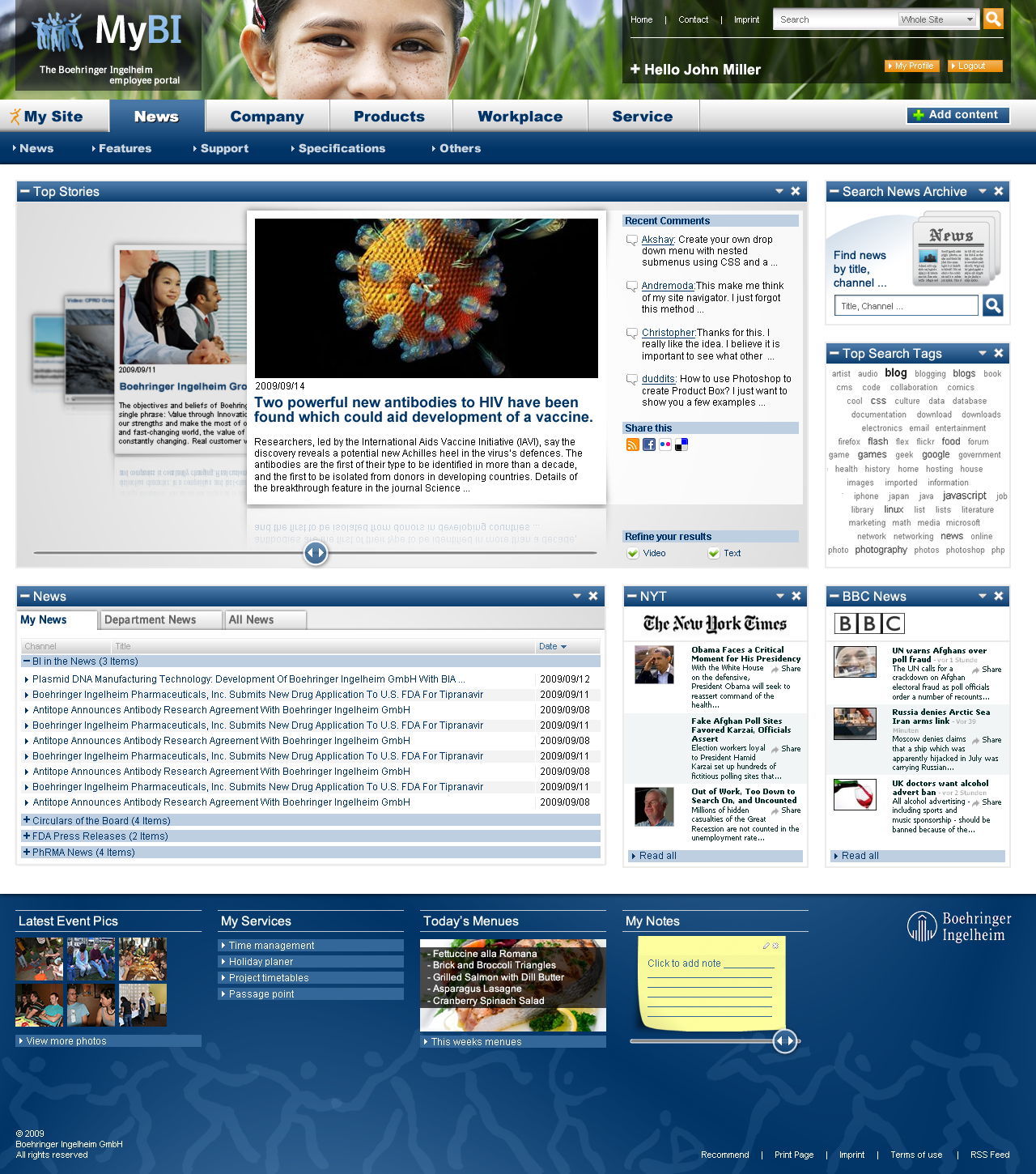
Create a role-aware, modular experience that surfaces relevant news, tools, alerts, and KPIs while enabling consistent layouts across departments and clear governance separating global standards from local customization.
As Global UCD Lead for the NetVision program, Jorge directed user-centered design strategy across a colocated team of approximately 100 cross-disciplinary staff worldwide operating in a follow-the-sun production model.
He served as strategic partner to Public Affairs and Communications leadership, orchestrating handoffs between work zones to support continuous production.
His responsibilities included business analysis, information architecture, solution definition, stakeholder alignment, and liaison work between global business stakeholders, regional teams, and IT delivery.
Collaboration included Public Affairs, Communications, HR, R&D, Finance, and IT stakeholders across Americas, EMEA, and APAC regions.
The work followed a research-led, structure-first design process with continuous validation. The approach emphasized research over opinion, structure before surface, and continuous usability validation.
Frame - Align and define
Discover - Research and empathize
Structure - Information architecture
Ideate - Explore concepts
Interact - Optimize flows
Design - Visual and systems
Validate - Test and reduce risk
Launch - Build and QA
Improve - Measure and learn
Conducted comprehensive stakeholder and business analysis in partnership with Public Affairs, Communications, HR, R&D, Finance, and IT to clarify global versus local ownership models and define success metrics tied to communication effectiveness and usability.
Identified core employee personas, including corporate, research, field, manufacturing, and leadership audiences, and mapped role-based needs for news, tools, applications, and collaboration to inform personalization and homepage logic.
Designed a global navigation framework balancing consistency and flexibility. Established content taxonomies, metadata, and tagging models to support findability and governance.
Defined page templates and modular components for reuse across departments, and created role-aware information architecture enabling personalized experiences while maintaining organizational coherence.
Produced detailed low-fidelity wireframes to align stakeholders early and establish shared vision across regions. Validated layout, hierarchy, and interaction patterns through iterative stakeholder reviews and usability feedback sessions.
Wireframes served as critical artifacts for governance discussions and phased rollout planning.
Key iterations focused on balancing global standardization with local flexibility requirements. Early feedback from regional stakeholders shaped personalization logic and content governance models.
Testing revealed the need for stronger emergency alert visibility and clearer pathways to compliance information, leading to architectural adjustments that prioritized critical communications while preserving departmental autonomy.
The initiative established a global intranet foundation enabling faster publishing, clearer content ownership, and reduced duplication of design effort.
The program created scalable information architecture and design systems supporting future enhancements while improving findability and consistency of internal communications.
It also helped socialize user-centered design practices within a traditionally IT-driven enterprise environment, demonstrating the value of information architecture, UX, and early stakeholder alignment at scale.
Enterprise UX at this scale is about governance, information architecture, alignment, and sustainable systems - not only screens. The value comes from making complexity legible enough for global teams to act consistently while preserving the flexibility local organizations need.