Client / Program
Medidata
Medidata
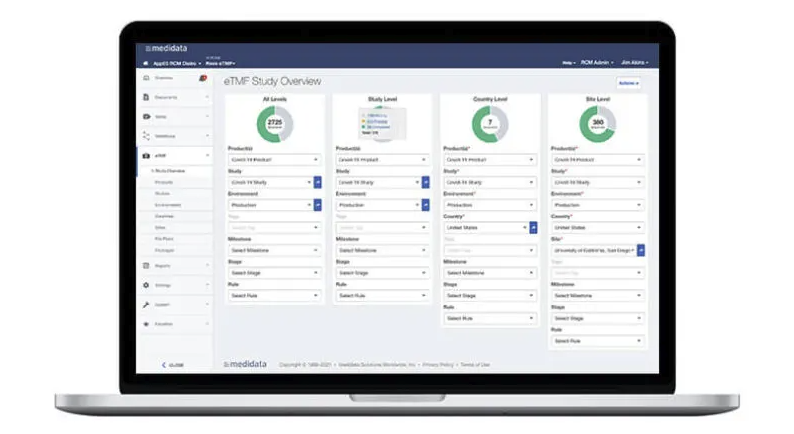
A next-generation clinical trial platform designed to unify fragmented workflows, improve study management usability, and support more efficient clinical trial operations.
Client / Program
Medidata
Role
Sr. UX/UI Consultant
Product
Enterprise SaaS / B2B Platform
Industry
Healthcare / Life Sciences
Scale
10-person cross-functional team
Medidata faced a significant challenge in the clinical trial space: fragmented tools, complex data workflows, and inconsistent user experiences made study management harder for clinical trial professionals.
As Sr. UX/UI Consultant, Jorge supported the design of a next-generation clinical trial platform focused on unifying workflows, improving usability, and creating a more cohesive enterprise SaaS experience.
Clinical trials require complex study management from design through submission. The objective was to create a more unified, usable, and efficient platform experience that could reduce fragmentation across tools and support clinical trial professionals through clearer workflows, dashboards, and product integration.
Clinical trials are a critical component of the healthcare industry, requiring teams to manage studies from design through submission.
Professionals in this space faced significant hurdles from a fragmented suite of tools. These tools often involved complex data workflows, inconsistent user experiences, steep learning curves, and disconnected interfaces.
The result was operational friction during critical study phases. Users needed a more integrated platform that could reduce cognitive load, improve data visibility, and support clinical trial workflows more effectively.
As Sr. UX/UI Consultant, Jorge worked across UX design, product management, and engineering to support the design of a next-generation clinical trial platform.
His responsibilities included UX strategy, interface design, stakeholder alignment, user research support, workflow analysis, prototyping, and collaboration with product and engineering teams.
The role required translating complex clinical trial workflows into clearer interaction models and helping align design outputs with product and operational goals.
The work involved a 10-person cross-functional team spanning UX design, product management, and engineering. Collaboration was primarily on-site and colocated, allowing close partnership with product and technical stakeholders throughout research, design, prototyping, and validation.
The work followed a research-led, structure-first design process with continuous validation. The approach emphasized research over opinion, structure before surface, and continuous usability validation.
Frame - Align and define
Discover - Research and empathize
Structure - Information architecture
Ideate - Explore concepts
Interact - Optimize flows
Design - Visual and systems
Validate - Test and reduce risk
Launch - Build and QA
Improve - Measure and learn
The team adopted a mixed-methods research approach that included user interviews, contextual inquiry, and usability testing.
The goal was to understand the pain points and workflows of clinical trial professionals. Key insights revealed that users often relied on disparate systems to complete their tasks, creating opportunities for errors, redundancies, and workflow delays.
Users expressed a need for a more integrated platform that could streamline processes and provide a cohesive experience across study management activities.
The information architecture strategy focused on creating a logical flow aligned with user workflows and critical clinical trial phases.
The team used activities such as card sorting and affinity mapping to inform taxonomy and organization.
Design decisions prioritized critical tasks and workflows, leading toward unified dashboard concepts that presented relevant data at a glance and improved navigation across the platform.
The team used rapid prototyping methods, including wireframes and interactive prototypes developed in tools such as Sketch and InVision.
Testing included multiple rounds of usability testing with users from the clinical trial domain.
This helped assess user interactions with the platform, identify usability issues early, and improve designs through direct feedback.
The design process included multiple iterations based on user testing and stakeholder review.
Early prototypes highlighted areas of confusion, particularly around navigation, data access, and workflow clarity.
Based on this feedback, the interface was refined to reduce cognitive load, improve hierarchy, and create a more streamlined user experience.
The design work supported key business objectives around reducing workflow fragmentation, improving platform usability, and helping clinical trial teams move through study management tasks with greater clarity.
By streamlining workflows, improving dashboard comprehension, and creating a more unified platform experience, the initiative contributed to stronger usability, better product consistency, and more efficient clinical trial management workflows.
Clinical trial platforms depend on clarity, workflow integration, and trusted data-rich experiences. In environments where teams manage complex studies across critical phases, strong information architecture and cohesive product systems help make work easier to understand and easier to act on.